A faster path to multi-state medical licensure for telemedicine, locum tenens, and career flexibility
If you want to practice across state lines, the Interstate Medical Licensure Compact (IMLC) offers qualified physicians an expedited pathway to licensure in participating jurisdictions. The Compact is not a national medical license, but it can make multi-state licensing faster and more manageable for physicians who want to practice in more than one state.
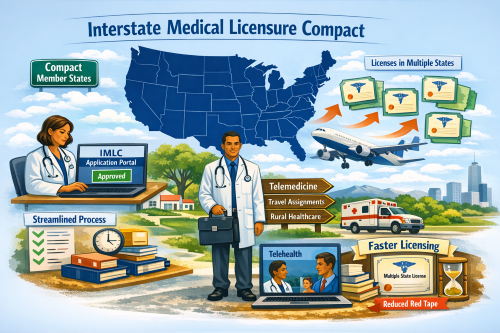
Quick IMLC Facts
- Average wait time for a license: 19 days.
- Average number of licenses obtained: 4.
- Licenses available within a week: 51%.
- Initial IMLC fee: $700, plus individual state license fees.
What States Are Part of the Interstate Medical Licensure Compact (IMLC)?
The Interstate Medical Licensure Compact (IMLC) includes jurisdictions that currently accept applications for expedited licensure, jurisdictions that participate but do not currently serve as a State of Principal Licensure (SPL), and jurisdictions where implementation is still in process or delayed.
- Alabama
- Arizona
- Colorado
- Connecticut
- Delaware
- District of Columbia
- Florida
- Georgia
- Guam
- Hawaii*
- Idaho
- Illinois
- Indiana
- Iowa
- Kansas
- Kentucky
- Louisiana
- Maine
- Maryland
- Michigan
- Minnesota
- Mississippi
- Missouri
- Montana
- Nebraska
- Nevada
- New Hampshire
- New Jersey
- North Carolina
- North Dakota
- Ohio
- Oklahoma
- Pennsylvania
- South Dakota
- Tennessee
- Texas
- Utah
- Vermont*
- Washington
- West Virginia
- Wisconsin
- Wyoming
- Arkansas
- New Mexico
- Rhode Island
- Alaska
- Massachusetts
Review the official IMLC participation map before applying.
How the Interstate Medical Licensure Compact Works
Eligible physicians apply through a State of Principal Licensure (SPL). If approved, the SPL issues a Letter of Qualification (LOQ), which physicians can then use to request licenses in other participating states. Each participating state still issues its own license and may have its own licensing fee or additional requirements.
IMLC vs Traditional State Licensing
The Interstate Medical Licensure Compact does not replace state licensure. Instead, it offers a voluntary, expedited pathway for qualified physicians, while licenses are still issued by the individual participating states.
Interstate Medical Licensure Compact (IMLC)
- Voluntary, expedited pathway for qualified physicians
- Starts through a State of Principal Licensure (SPL)
- If approved, the SPL issues a Letter of Qualification (LOQ)
- The LOQ can be used to request separate licenses in participating states
- Designed to streamline multi-state licensure
- Initial application fee is $700, plus individual state license fees
- All fees are non-refundable
Traditional State Licensing
- Uses the standard state licensing process
- Licenses are still issued by the individual state medical board
- Licensing remains state-based
- The process does not create a national medical license
- State-specific rules, fees, and requirements still control the final license issued
Who Qualifies for the IMLC?
Qualified physicians generally must hold a full, unrestricted medical license in a participating SPL state and meet the Compact’s standards for medical education, graduate medical education, exam history, specialty certification, and background review. The official application guidance also states that applicants must not have disqualifying disciplinary history, criminal history, controlled substance actions, or a current investigation.
Physicians should generally meet the following requirements:
- Full, unrestricted medical license in a participating SPL state.
- Required education and graduate medical education credentials.
- Accepted licensing exam history within the stated attempt limits.
- Current specialty certification or time-unlimited certification by an accepted board.
- No disqualifying disciplinary or criminal history.
How to Apply for the IMLC
Qualified physicians begin through a State of Principal Licensure (SPL), review the Compact rules, and then apply through the IMLC portal.
Confirm that you qualify
You must hold a full, unrestricted medical license in a compact-member state that can serve as your State of Principal Licensure (SPL) and hold current specialty certification or time-unlimited certification from an accepted board.
Confirm your SPL eligibility
At least one of the following must apply:
- Your primary residence is in the SPL
- At least 25% of your practice of medicine occurs in the SPL
- Your employer is located in the SPL
- You use the SPL as your state of residence for U.S. federal income tax purposes
Review the Compact Rules and Definitions
Before applying, physicians should review the official IMLC rules and confirm that they meet the eligibility requirements.
Create your account and apply online
Register through the IMLC portal using your email address, username, and password to begin the application process.
Complete background review and receive your LOQ
A background check is required for all Letter of Qualification applications, and fingerprint requirements vary by state. If approved, you will receive a Letter of Qualification (LOQ), which you can use to request separate licenses in other participating states.
Why the IMLC Matters for Locum Tenens and Telemedicine
The IMLC is especially relevant for physicians practicing across state lines. Official and industry sources describe the Compact as a faster pathway for qualified physicians who want to work in multiple states and note that it can support telemedicine and improve access to care in rural and underserved areas.
For physicians, that can mean:
- Better access to opportunities that require multi-state licensure.
- A more efficient path for telemedicine expansion across state lines.
- A streamlined option for physicians who expect to practice in multiple participating states.
Is It Right for You?
If you expect to practice in multiple states, the Interstate Medical Licensure Compact may be a practical option to consider. It is designed to streamline the licensing process for qualified physicians, while still preserving state-by-state licensure.
Ready to Explore Physician Opportunities?
At MDstaffers, we connect physicians with high-quality locum tenens and permanent opportunities across the country. If you are exploring roles that may benefit from multi-state licensure, we are here to help.
We offer:
- Nationwide physician opportunities.
- Support throughout the hiring process.
- Flexible options aligned with your goals.
Final Thoughts
The Interstate Medical Licensure Compact can help qualified physicians reduce licensing friction and move more efficiently into additional participating states. For physicians interested in locum tenens, telemedicine, or broader multi-state practice, it is an important pathway to understand.
Interested in exploring physician opportunities?
Contact MDstaffers to get started or explore MDstaffers jobs to find current openings.
Frequently Asked Questions About the IMLC
Have questions about IMLC requirements, costs, and the application process? These quick answers cover the basics physicians should review before applying.
What is the Interstate Medical Licensure Compact (IMLC)?
The Interstate Medical Licensure Compact (IMLC) is a voluntary, expedited pathway to licensure for qualified physicians who want to practice in multiple states. Physicians who qualify can apply through the Compact and receive separate licenses from each participating state they select.
Is the IMLC a national medical license?
No. The IMLC does not issue one national medical license. Licenses are still issued by the individual participating states, and each state may have its own licensing fee, renewal schedule, or additional requirements.
Who qualifies for the IMLC?
In general, physicians must hold a full, unrestricted medical license in a compact-member state that can serve as their State of Principal Licensure (SPL), meet at least one SPL requirement, and satisfy the Compact’s general eligibility standards for education, graduate medical education, exam history, specialty certification, and background review.
The official guidance also states that applicants must not have disqualifying disciplinary history, criminal history, controlled substance actions, or a current investigation.
What is a State of Principal Licensure (SPL)?
A State of Principal Licensure (SPL) is the compact-member state that processes your initial application and issues your Letter of Qualification (LOQ). To qualify for an SPL, you must hold a full, unrestricted medical license in that state and meet at least one SPL condition:
- Your primary residence is in the SPL
- At least 25% of your practice of medicine occurs in the SPL
- Your employer is located in the SPL
- You use the SPL as your state of residence for U.S. federal income tax purposes
How much does the IMLC cost?
The initial IMLC application fee is $700, plus the individual licensing fees for each participating state where you want to practice. All fees are non-refundable. You can review the official cost page here: https://imlcc.com/what-does-it-cost/.
How long does the IMLC process take?
Timelines vary. The SPL verification process, including fingerprint-based national criminal background checks and other qualification review steps, may take several weeks. After you qualify and pay the required state-license fees, participating boards usually issue licenses in only a few days.
How long is a Letter of Qualification (LOQ) valid?
Letters of Qualification are valid for 365 days from the date of issuance. If your LOQ is still valid, you may use the Compact to select additional participating states.
Which states currently participate in the IMLC?
Participation can change, so physicians should review the official IMLC participation map before applying. The map identifies jurisdictions currently accepting expedited licensure applications, jurisdictions that do not currently serve as SPL states, and jurisdictions where implementation is still in process or delayed.
Can physicians use the IMLC for telemedicine or locum tenens work?
The Compact was created to help qualified physicians obtain licenses more efficiently in multiple states. That can be especially useful for physicians pursuing telemedicine, locum tenens assignments, or other multi-state practice opportunities.
Disclaimer
This guide is for informational purposes only. It is not legal, licensing, tax, or credentialing advice. Eligibility requirements, fees, timelines, participation status, and state-specific licensure rules can change, and individual state medical boards may request additional information after a license is issued. Physicians should verify all current requirements directly with the IMLC and the applicable state medical boards before applying.